

Sweden’s Gateway to Continental Europe
The Port of Trelleborg is Scandinavia’s largest RoRo port and one of Sweden’s most important transport and logistics hubs. With its strategic location at the southernmost tip of Sweden, frequent ferry connections and efficient transport solutions, the port serves as a vital link between Scandinavia and continental Europe.
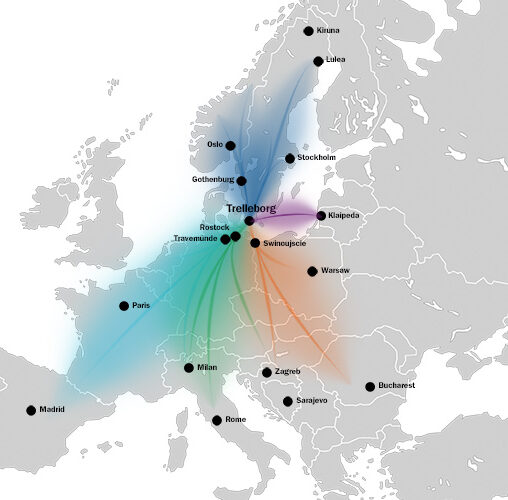 Every day, nearly 30 ferry arrivals and departures take place at the Port of Trelleborg. The shipping companies TT-Line, Stena Line and Polsca Baltic Ferries operate a total of 14 RoPax vessels, providing regular connections to Travemünde and Rostock in Germany, Swinoujscie in Poland and Klaipeda in Lithuania.
Each year, large volumes of cargo, trucks, trailers, passenger cars and passengers pass through the port. The Port of Trelleborg is Sweden’s second-largest port in terms of cargo volume, handling approximately 12 million tonnes of cargo annually.
A modern port with high capacity
The Port of Trelleborg offers well-developed infrastructure for the efficient handling of both freight and passenger traffic. The port has eight ferry berths for regular services, two of which are equipped with railway connections, as well as quays for handling commodities such as grain and petroleum products.
With water depths ranging from 6.8 to 8.5 metres and the capacity to accommodate vessels up to 240 metres in length, the port provides excellent conditions for large vessels and efficient cargo flows.
A key hub for intermodal transport
The Port of Trelleborg is also the largest railway port in the Baltic Sea region and an important hub connecting sea, rail and road transport. By integrating different modes of transport, the port enables flexible and efficient logistics solutions for businesses.
As one of Sweden’s five core ports within the EU’s Trans-European Transport Network (TEN-T), the Port of Trelleborg plays a strategic role in both Swedish and European trade.
Developing the sustainable port of the future
The Port of Trelleborg is continuously evolving to meet future transport demands. Investments in modern port infrastructure, onshore power supply, renewable energy and electrification are creating the conditions for increased capacity, more efficient cargo flows and reduced environmental impact.
The ambition is to further strengthen the port’s position as a sustainable and competitive transport hub – today and in the future.